
Quick answer
For most Twin Cities basements, waterproof luxury vinyl plank (LVP) is the best all-around flooring choice. It runs roughly $4 to $16 per square foot installed, holds up to the moisture and temperature swings that come standard with below-grade concrete, and looks like real wood or stone. Epoxy coatings ($4 to $10 per square foot) are the better pick for basement gyms, workshops, and mudrooms, while carpet tile ($2 to $8 per square foot) still wins for media rooms and playrooms as long as it sits over a proper moisture barrier.
The wrong choice costs more than money. Solid hardwood, standard carpet padding, and un-sealed concrete are all vulnerable to the humidity, minor seepage, and vapor pressure that basements in Minnesota deal with every spring thaw and summer. Picking the right material up front is what keeps a finished basement finished.
Why basement flooring is different from every other floor in your house
A basement slab sits below grade, in direct contact with soil that holds moisture year-round. Even a basement that has never flooded will push water vapor up through the concrete, especially during Minnesota's freeze-thaw cycles and humid summer months. That vapor pressure is what causes moisture to wick into flooring materials that aren't built to handle it — think cupping hardwood, moldy carpet pad, or tile that pops loose from an unsealed subfloor.
That's why basement flooring isn't just a style decision. It's a moisture-management decision first, and a design decision second. The good news is that today's waterproof flooring options don't force a trade-off between durability and looks.
Comparing your basement flooring options
Luxury vinyl plank (LVP) — $4 to $16 per square foot installed
LVP is the most popular basement flooring choice for a reason: rigid-core waterproof planks can be installed directly over clean, level concrete without an underlayment, they won't swell or warp if they get wet, and modern designs convincingly mimic hardwood, stone, or tile. For basements, look for a wear layer of at least 12 mil for durability in higher-traffic rec rooms. Sheet vinyl runs cheaper, at roughly $2 to $7 per square foot, but offers less design flexibility than plank formats.
Epoxy flooring — $4 to $10 per square foot
Epoxy coatings bond directly to sealed concrete, resist stains and moisture, and hold up well to heavy equipment — which makes epoxy the go-to for home gyms, workshops, and basements that double as storage or utility space. It's not the coziest option underfoot, but it's one of the most durable and lowest-maintenance.
Carpet tile — $2 to $8 per square foot
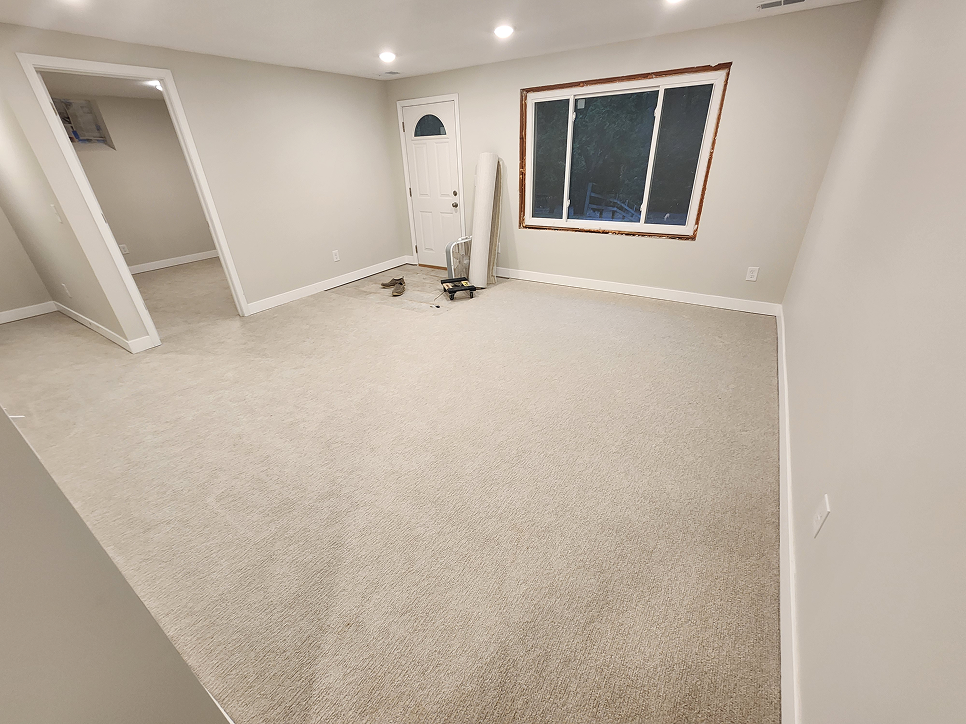
Carpet tile still makes sense for basement media rooms, playrooms, and guest bedrooms where comfort matters most. The key requirement: it needs a waterproof underlayment or moisture barrier between the tile and the slab, since standard carpet pad will trap moisture and encourage mold growth in a below-grade space. Individual tiles also make repairs easy — a stained or damaged section can be swapped out without redoing the whole floor.
Ceramic and porcelain tile — $12 to $50 per square foot
Tile is naturally water-, stain-, and mold-resistant, which makes it a strong choice for basement bathrooms or laundry areas. Porcelain runs $15 to $50 per square foot installed and ceramic $12 to $40, both well above LVP, so most homeowners reserve tile for wet zones rather than the whole basement footprint.
Engineered hardwood — $7 to $20 per square foot (and why we're cautious about it)
Engineered hardwood can work in a basement, but only with a proper vapor barrier installed over the concrete subfloor first, and it should be avoided entirely in basements with any history of moisture issues. Solid hardwood should never go below grade — it will cup, warp, or buckle. If a homeowner wants a genuine wood look, we typically steer them toward a wood-look LVP instead, which gets the aesthetic without the risk.
Minnesota code and moisture requirements that affect your flooring choice
Because basement flooring sits on top of a moisture-prone slab, Minnesota's building code has specific requirements that shape what a contractor can install and how. Since 2009, Minnesota has required radon-resistant construction techniques in new construction, and the same principles apply when a basement is finished: a layer of clean aggregate under the slab, a 6-mil polyethylene vapor barrier lapped at least 12 inches at the seams, and a sealed vent pipe system to direct soil gases outdoors before they reach the living space. A passive radon system is the baseline; homeowners in older Twin Cities homes without one can have a fan added to convert it to an active system.
In Minneapolis specifically, finishing a basement requires building, electrical, and plumbing permits, with permit fees typically running $100 to $1,000 depending on project scope, and roughly a three-week approval window for standard projects. If your finished basement includes a bedroom, Minnesota's egress window requirements come into play as well — a legal bedroom needs a code-compliant escape window, which is worth planning for before flooring and framing decisions are finalized. Other cities across our service area, including Edina, Minnetonka, and St. Paul, follow similar permit and inspection structures through their own building departments, though fees and timelines vary by jurisdiction.
One inspection detail that trips up a lot of DIY basement finishers: fiberglass batt insulation installed directly against concrete is flagged as a mold risk during inspection. Insulation and vapor barrier placement need to be appropriate for a below-grade application and meet the R-values required for our climate zone — another reason flooring, insulation, and moisture control should be planned together rather than as separate decisions.
2026 basement flooring trends in the Twin Cities
This year, we're seeing a clear shift away from cool gray LVP tones toward warmer honey, caramel, and light oak finishes, along with wide, long-format planks that make a basement rec room feel less like a basement and more like an extension of the main living floor. Matte and textured finishes are replacing high-gloss looks, and for basements specifically, we're recommending wear layers of 12 mil or thicker to hold up to foot traffic, pets, and home gym equipment over the long haul.
Frequently asked questions
Is LVP or tile better for a basement?
Both are waterproof and basement-appropriate, but LVP is usually the better value for full basement footprints since it costs less per square foot and installs faster. Tile makes more sense in smaller wet areas, like a basement bathroom or laundry nook, where its durability and water resistance matter most.
Can I put carpet in a Minnesota basement?
Yes, as long as it's installed over a proper waterproof underlayment or moisture barrier rather than standard carpet pad. Without that barrier, basement humidity and minor moisture can lead to mold growth underneath the carpet, which is a common and preventable mistake.
Do I need a permit just to install basement flooring?
Flooring alone typically doesn't require a separate permit, but if it's part of a larger basement finishing project — especially one that includes framing, electrical, plumbing, or a bedroom with an egress window — the overall project will need building, electrical, and/or plumbing permits depending on scope.
How do I know if my basement has a moisture problem before choosing flooring?
A simple test is taping a square of plastic sheeting to the slab and checking after 24 to 48 hours for condensation underneath. Any active moisture, visible efflorescence (white mineral deposits), or musty odor should be addressed — and often means sealing the concrete or improving drainage — before any flooring goes down, regardless of which material you choose.
Ready to finish your basement the right way?
Choosing the right basement flooring is easier with a design-build team that also handles the moisture control, insulation, and permitting behind it. Executive Remodeling proudly serves homeowners across the Twin Cities metro, including Edina, Minneapolis, Minnetonka, and St. Paul, with basement remodels built to hold up to Minnesota's climate. Curious what a full basement remodel costs beyond flooring? Reach out to schedule a consultation and we'll help you plan a basement that's comfortable, code-compliant, and built to last.
.avif)